Best Credit Cards for Airbnb Hosts


Choosing the right credit card can have a real, measurable impact on your bottom line as a short-term rental operator. The best credit cards for Airbnb hosts help turn everyday hosting expenses like cleaning supplies, furniture purchases, utility bills and marketing into valuable credit card rewards that directly boost profitability.
In this article, we focus on business credit cards that are specifically beneficial for short-term rental professionals and vacation rental managers. We highlight cards that maximize rewards on hosting-related expenses while also helping you build business credit. Personal travel cards aimed primarily at guest bookings are outside this scope, as they typically don’t perform as well for hosts with ongoing operational spending.
Key takeaways
Establishing a dedicated business credit card separates personal and business finances, which simplifies tax preparation and builds a credit history for your rental entity.
The most profitable credit card strategy involves selecting a card with reward categories that align specifically with your largest operational expenses.
Business credit cards often provide specialized perks like free employee cards for staff and purchase protection for property furnishings that personal cards do not offer.
Hosts can maximize value by timing new card applications to coincide with significant upcoming costs to easily meet sign-up bonus spending requirements.
Combining multiple cards, such as pairing a high-yield category card with a flat-rate cash back card, allows hosts to capture the highest possible rewards across all types of business spending.
What are the benefits of credit cards for Airbnb hosts?
A dedicated credit card works very differently for your hosting business than a personal card. Business credit cards often offer flexible spending capacity, along with helpful features like free employee cards for property managers or cleaning staff.
For hosts managing one or multiple properties with short-term rental software like Hostaway, the right business credit card can turn routine expenses into consistent rewards opportunities.
Business expense management
Separating business expenses means routing all rental property related costs through a dedicated business credit card. This creates automatic categorization for bookkeeping and tax preparation, making financial tracking much easier and providing clear documentation for audits.
Airbnb hosts typically deal with a wide range of expenses, including cleaning supplies, furniture purchases, property management software subscriptions, internet services, smart locks and advertising on platforms like Facebook or Google. Using a single business card captures all of these transactions in one place and provides you with detailed statements that eliminate manual sorting and reduce accounting errors, ultimately simplifying rental property finance management. A dedicated credit card also helps clearly separate business and personal finances, an essential best practice for any host.
Reward maximization opportunities
Many hosting expenses align well with specific business credit card bonus categories. For example, internet and phone services used for smart property management can earn bonus rewards on cards like the Chase Ink Business Preferred. Office supply purchases, including gift cards for operational needs, can earn 5% back on the Chase Ink Business Cash card.
When spending is organized and matched to the right categories, rewards can compound quickly. Thoughtful category optimization often generates significantly higher returns than relying on a single flat-rate card.
Credit cards with 0% introductory APR offers can also be helpful for vacation rental hosts planning large upfront purchases, such as furniture or property upgrades. High reward rates remain especially important for travel-related expenses tied to property management.
Building business credit
Using a business credit card consistently helps establish your hosting operation as a legitimate commercial entity. For sole proprietors and LLCs, responsible card usage may be reported to business credit bureaus over time, helping unlock higher credit limits and more favorable financing options.
This foundation becomes increasingly important as you scale to multiple properties or pursue loans for renovations and property improvements. Understanding these benefits makes it easier to evaluate which card features best support your long-term growth.
Protections
Many business credit cards also include valuable protections, such as purchase protection and extended warranties, which can be especially useful when buying furniture, appliances or equipment for vacation rental properties.
What are the key features to evaluate in Airbnb host credit cards?
With these benefits in mind, choosing the best business credit card becomes much more straightforward. The best credit card for Airbnb hosts is the one whose rewards structure closely matches how you actually spend money.
Ideally, credit cards should offer 2–5% cash back, no foreign transaction fees and purchase protections relevant to property management.
Reward categories and rates
Different credit cards reward hosting expenses at very different rates. For instance, furniture purchases from retailers like Wayfair may earn 2% on flat-rate cards, but could qualify for higher bonus categories with certain issuers. Utility bills, cell phone protection benefits and internet services — critical for smart home management — earn 3x points on the Chase Ink Business Preferred.
Advertising spend on platforms like Google Ads or Facebook often also qualifies for 3x rewards on select business cards, making them particularly valuable for short-term rental owner investing in listing visibility. Knowing which purchases trigger bonus credit card rewards is key to understanding a credit card’s true value.
Sign-up bonuses and annual fees
Welcome bonuses often deliver the highest value in the first year. For example, the Chase Ink Business Preferred offers 100,000 bonus points after $8,000 in spending within the first three months of account opening, with a $95 annual fee.
To evaluate whether a card is worth it, calculate the break-even point by comparing the annual fee to the additional rewards you expect to earn versus a no-fee alternative. For hosts making large purchases such as seasonal furniture refreshes or setting up a new property, meeting spending requirements for sign-up bonuses is often very achievable.
Business-specific benefits
Business cards often include features that go beyond rewards. Purchase protection can safeguard furniture and equipment against damage or theft, while statement credits, expense tracking tools and free employee cards add practical value beyond rewards.
Travel insurance and car rental cars can benefit vacation rental hosts who travel frequently between properties or for market research. For example, the Capital One Venture X includes $300 in annual travel credits and airport lounge access, which can be useful for short-term rental host networking events and property inspections.
Key evaluation criteria:
Rewards rate on your largest spending categories
Annual fee relative to expected earnings
Bonus requirements achievable within your cash flow
Business-specific protections relevant to property management
These factors set the stage for the card recommendations below.
Top credit card recommendations for Airbnb hosts
Based on the evaluation framework above, four credit cards stand out for different Airbnb hosting business needs. Each option below works best for a specific spending style or growth stage.
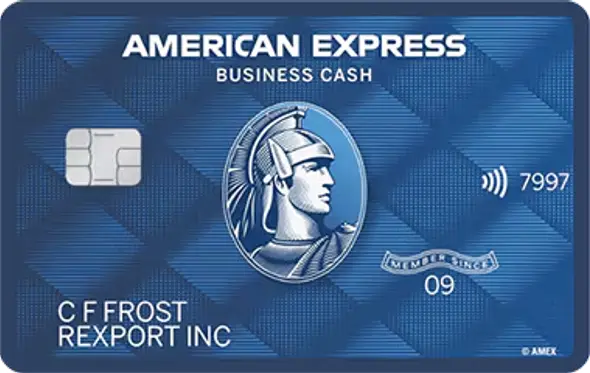
Best for cash back: American Express Blue Business Cash Card
The Blue Business Cash Card suits hosts who value simplicity and don’t want to track rotating or complex categories. Its straightforward cash approach works well for single-property hosts or those just starting with vacation rental software and want reliable returns without optimization complexity.
Rewards structure: 2% cash back on all eligible purchases up to $50,000 per account anniversary year (then 1%), automatically applied as a statement credit
Annual fee: $0, making it an affordable choice for cost-conscious hosts
Sign-up bonus: $250 statement credit after $3,000 spend in first three months
Best use cases: Hosts with under $50,000 in annual expenses, diverse spending across non-bonus categories and/or preference for cash rewards over travel points
The preset spending limit adjusts based on usage patterns, potentially offering higher credit limits as your Airbnb business grows.

Best for travel rewards: Chase Ink Business Preferred Credit Card
For hosts who frequently travel between properties or want maximum value from bonus categories, the Chase Ink Business Preferred Credit Card delivers excellent returns on typical hosting expenses. Its travel benefits and transfer partners also create outsized value for points earned.
Rewards structure: 3x points on travel, shipping, internet/cable/phone services and advertising purchases made with social media sites and search engines(up to $150,000 combined annually)
Transfer partners: Points transfer 1:1 to airlines and hotels partners like Marriott Bonvoy
Annual fee: $95
Best for: Multi-property hosts with significant spending on advertising, internet services, shipping for supplies and travel for property management and business growth

Best for high spenders: Capital One Spark Cash Plus
Hosts with substantial monthly expenses across multiple properties benefit from Capital One Spark Cash Plus’s unlimited structure. As a charge card requiring full monthly payment, it suits hosts with consistent cash flow seeking maximum cash rewards without category complexity.
Rewards structure: Unlimited 2% cash back on every purchase, ideal for hosts exceeding $100,000 annually in business expenses
Payment structure: Charge card requiring full monthly payment; no preset spending limit accommodates variable monthly costs
Bonus: $2,000 cash bonus after $30,000 spend, with tiered bonuses available
Additional perks: Unlimited 5% cash back on hotels and rental cars booked through Capital One Business Travel
Annual fee: $150, refunded if annual spend hits a minimum of $150,000
Best for: High-volume furniture purchases, large cleaning service contracts, property management software subscriptions, other purchases across many categories and scaling operations
The Capital One Spark Cash Plus card removes the $50,000 cap found on some flat-rate cards, making it well suited for growing vacation rental businesses.

Best for everyday expenses: Chase Ink Business Cash
Hosts focused on maximizing returns in specific categories should consider Chase Ink Business Cash Credit Card. Its 5% categories create exceptional value for targeted spending, particularly office supplies and internet services.
Rewards structure: 5% cash back on the first $25,000 combined spend at office supply stores and on internet, cable and phone services;
Additional bonus rewards: 2% cash back on gas and dining (first $25,000 combined); unlimited 1% cash back on all other purchases
Annual fee: $0
Sign-up bonus: $750 after $6,000 spend in the first three months
Many hosts buy Airbnb gift cards at office supply stores, yielding about 5% returns on cleaning fees and guest experiences, significantly outperforming flat-rate alternatives. Short-term rental operators often pair this card with the Chase Ink Business Preferred to pool Ultimate Rewards points and maximize coverage.
Comparison summary
Credit Card | Best for | Rewards structure | Sign-up bonus | Annual fee |
American Express Blue Business Cash Card | Simple cash back | 2% cash back on all eligible purchases up to $50,000 per year (then 1%) | $250 statement credit after $3,000 spend in first 3 months | $0 |
Chase Ink Business Preferred Credit Card | Travel rewards & bonus categories | 3x points on travel, shipping, internet/cable/phone services, and advertising (up to $150,000 combined annually) | 100,000 points after $8,000 spend in first 3 months | $95 |
Capital One Spark Cash Plus | High spenders & scaling businesses | Unlimited 2% cash back on all purchases | $2,000 cash bonus after $30,000 spend (tiered bonuses available) | $150 (refunded with $150,000 annual spend) |
Chase Ink Business Cash Credit Card | Everyday business expenses | 5% cash back on office supplies & internet/cable/phone (first $25,000 combined annually); 2% on gas & dining (first $25,000); 1% on all other purchases | $750 after $6,000 spend in first 3 months | $0 |
Choosing the right card comes down to spending patterns. Hosts with heavy category spending often maximize value with the Ink Business Preferred, while those who prefer simplicity or have diverse, hard-to-categorize expenses may gravitate toward flat-rate cards like Spark Cash Plus or Blue Business Cash. Many strategic hosts combine multiple cards to cover the widest range of expenses.
Additional options worth noting include the American Express Green Card, which earns 3x points on travel including Airbnb purchases, and the Capital One Venture X Rewards, which offers 2x miles on all purchases.
Many of the best business credit cards for Airbnb hosts require at least good personal credit for approval.
Common challenges and solutions
Even with the right cards selected, Airbnb owners can run into challenges in maximizing credit card value. Fortunately, most have simple solutions.
Challenge 1: Mixing personal and business expenses
Solution:
Designate one card exclusively for short-term rental operational expenses and review statements monthly to catch mistakes early. Also, set up a separate bank account for hosting income and expenses.
This separation simplifies tax preparation and creates defensible documentation if questioned about business deductions.
Challenge 2: Meeting spending requirements for bonuses
Solution:
Apply for new credit cards when large expenses are coming up, such as furnishing a new property or upgrading a new one with a luxury amenity like a swimming pool.
Prepay quarterly expenses like cleaning contracts or advertising when possible. Sync card applications with property onboarding when setup costs are highest. Avoid manufacturing spend or carrying balances that generate interest charges, which quickly erode bonus value.
Challenge 3: Managing multiple cards effectively
Solution:
Assign each card a clear role based on spending category. For example, use the Ink Business Cash for office supplies and internet, Ink Business Preferred for travel and advertising, and a flat-rate card for everything else. Hosts can maximize credit card rewards by putting all eligible expenses on their card, including cleaning supplies and utilities.
Set calendar reminders for annual fee dates and welcome bonus deadlines, and review rewards quarterly to ensure your strategy is working.
Paying credit card balances in full each month helps avoid interest charges that can cancel out rewards. Hosts should monitor their credit card performance to ensure that the rewards earned justify any annual fees associated with the card.
Many hosts find that three strategically-chosen cards maximize reward capture without becoming unmanageable. Successful implementation of these strategies leads to substantial annual savings.
A smarter credit card strategy for Airbnb hosts
The best credit cards for Airbnb hosts align rewards structures with actual hosting expenses. The right choice depends entirely on your spending patterns, the scale of your short-term rental business and whether you prefer cash rewards or travel points.
Next steps:
Review the last three months of hosting expenses to identify your largest spending categories
Compare your spending against the bonus categories of recommended cards
Apply for the card that maximizes rewards on your actual expenses (consider Chase’s 5/24 rule limiting approvals for those with 5+ new cards in 24 months)
Separate business and personal finances immediately (even if you are the vacation rental owner, manager and host)
Set up expense tracking through Hostaway vacation rental management software
Refer to IRS Publication 527 as it applies to hosting expenses
FAQs
Why should Airbnb hosts use a dedicated business credit card instead of a personal one?
Using a dedicated business credit card separates business and personal finances, which is an essential best practice. It creates automatic categorization for bookkeeping and tax preparation, providing clear documentation for audits. Additionally, business cards often offer higher spending capacity, free employee cards for staff and specific reward categories that align with rental property expenses.
How do I find the best credit cards for Airbnb hosts?
You should look for a card with a rewards structure that matches your actual spending patterns. Key criteria when evaluating include the rewards rate on your largest spending categories, the annual fee relative to your expected earnings, whether you can achieve bonus requirements within your cash flow and business-specific protections like purchase protection for furniture or equipment.
What is the best credit card for Airbnb hosts who prefer simple cash back without tracking categories?
The American Express Blue Business Cash Card is recommended for hosts who value simplicity. It offers a straightforward structure with 2% cash back on all eligible purchases up to $50,000 per year (then 1%), automatically applied as a statement credit. It has a $0 annual fee, making it ideal for cost-conscious hosts or those just starting out.
How can hosts meet the high spending requirements for sign-up bonuses?
Hosts can time their credit card applications to coincide with large upcoming expenses, such as furnishing a new property or performing upgrades. Other strategies include prepaying quarterly expenses like cleaning contracts or advertising. However, hosts should avoid carrying balances that generate interest, as this erodes the value of the bonus.
Can I use multiple credit cards to maximize my rental business rewards?
Yes, many strategic hosts combine multiple cards to cover a wider range of expenses. For example, a host might use the Chase Ink Business Cash for office supplies and internet, the Chase Ink Business Preferred for travel and advertising and a flat-rate card for all other purchases. This strategy ensures the highest possible returns on different spending categories.
Ready to find out how Hostaway can transform your business?