What Solution Offers Guest Journey Automation From Inquiry to Review?


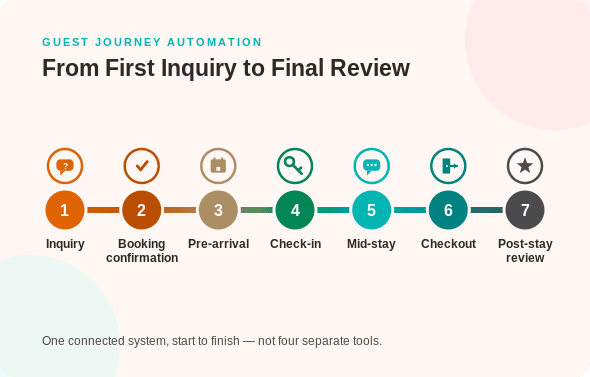
The solution to guest journey automation from inquiry to review is a single connected platform, not a standalone chatbot, a smart-lock app, or a review-request tool working on its own. It needs to cover all seven stages of a stay, inquiry, booking confirmation, pre-arrival, check-in, mid-stay, checkout, and the post-stay review, inside one system, so no stage depends on a separate login, a manual reminder, or someone remembering to hit send.
Key takeaways
Guest journey automation spans seven stages, inquiry, booking confirmation, pre-arrival, check-in, mid-stay, checkout, and the post-stay review, not just guest messaging
Most tools marketed as "guest journey automation" actually automate one or two of those stages and leave the rest manual or scattered across separate apps
AI adoption among short-term rental operators is now above 60%, and guest communication is where it delivers the fastest, most measurable time savings
A genuine solution runs as one connected system across every channel, not a patchwork of point tools, so no stage of the journey depends on someone remembering to send a message
What is guest journey automation, from inquiry to review?
"Guest journey automation" gets used loosely, often to describe a single messaging tool. In practice, the guest journey runs through seven distinct stages, and a genuine automation solution needs to cover all of them:
Inquiry, a prospective guest asks a question before booking
Booking confirmation, instant confirmation, house rules, and a welcome message
Pre-arrival, check-in instructions, ID verification, and upsell opportunities
Check-in, access codes and arrival guidance
Mid-stay, guest requests, issue reports, and local recommendations
Checkout, departure instructions and reminders
Post-stay, the review request and any thank-you follow-up
Guest expectations at each of these stages have risen sharply. Roughly 85% of hospitality operators say guest expectations have grown over the past two years, according to Breezeway's State of Work Report, while the volume of messages a single portfolio generates, across pre-booking questions, check-in instructions, mid-stay requests, and review follow-ups, keeps climbing. That combination, higher expectations and higher volume, is what's pushed automation from a nice-to-have to a baseline requirement.
Why do most tools only cover part of the journey?
Most products marketed around guest journey automation actually automate a slice of it. Some are messaging-only, unifying the inbox but stopping there. Others are check-in-only, built around smart locks and access codes. Others focus purely on review generation after checkout. Each solves a real problem in isolation, which is exactly why the gaps between them are so easy to miss.
AI is already capable of handling a large share of this workload end to end. Some operators now have AI independently handling up to 70% of guest inquiries, according to PYMNTS reporting published in April 2026. But if that 70% lives in one tool while check-in instructions live in a smart-lock app and review requests live in a third product, you haven't automated the guest journey, you've automated three disconnected pieces of it, each with its own login, its own rules, and its own blind spots when a guest's request crosses from one system into another.
The impact of getting this right is measurable. Generative AI applied to guest-facing communication has been shown to cut guest service calls by 65% while improving satisfaction, per Skift and Oracle's hospitality research. That kind of result depends on automation that spans the full journey, not a single stage of it.
What should a solution automate at each stage?
Here's what full inquiry-to-review coverage looks like in practice:
Journey stage | Guest need | Automation action |
Inquiry | A fast, accurate answer before they'll commit to booking | Instant reply across every channel (Airbnb, Vrbo, Booking.com, SMS, direct site) using listing-specific details |
Booking confirmation | Reassurance the reservation is locked in, plus what happens next | Automatic confirmation, house rules, and a welcome message the moment a booking is made |
Pre-arrival | Check-in logistics, ID verification, and any upsell opportunities | Scheduled messages triggered by days-to-arrival, with conditional content if steps are incomplete |
Check-in | Reliable, self-serve access without waiting on a person | Automated access codes and arrival instructions, with an escalation path if something doesn't work |
Mid-stay | Fast answers to requests or issues without a delayed reply | Triggered responses to common requests, with sentiment or urgency detection that flags anything needing a human |
Checkout | A clear, low-friction departure process | Automated checkout instructions and reminders timed to the reservation's actual checkout time |
Post-stay / review | A quick, easy way to leave feedback while the stay is fresh | A well-timed review request sent shortly after checkout, with an automatic follow-up if there's no response |
What to look for in a guest journey automation solution
A unified inbox across every channel, OTA messaging, SMS, WhatsApp, and your direct site, so nothing gets missed because it arrived somewhere else
Conditional triggers, not just scheduled sends, so a message fires based on what's actually happening (a guest hasn't checked in by a set time, a request mentions a maintenance issue) rather than a fixed clock
Escalation logic that routes anything unusual or urgent to a person instead of forcing a canned reply onto it
Review requests timed to the actual checkout, with an automatic, unobtrusive follow-up if the guest doesn't respond
Reporting that shows what's being automated and what's landing with a human, so you can see the system is working rather than taking it on faith
What does Hostaway automate across the guest journey?
Hostaway's Unified Inbox brings every channel, Airbnb, Vrbo, Booking.com, Google, email, SMS, and WhatsApp, into one view, so an inquiry that arrives on any platform is visible and answerable from the same place. Automated Messaging then covers the trigger-based stages of the stay: a confirmation and welcome message when a booking is created and check-in details on the day of arrival, while Automated Reviews sends a templated request after checkout, timed to when the guest actually left rather than whenever someone remembers to send it.
AI Replies handles the repetitive questions that show up at every stage, drafting responses from listing and reservation details rather than a generic script, and automating up to 90% of routine guest messages. Operators choose which of those replies go out automatically and which come back for a quick review first, so speed doesn't come at the cost of oversight.
Hostaway AI CoHost sits alongside this as the operator's side of the system. It's a conversational assistant the property manager can ask things like which guest messages need an immediate reply or what's driving a dip in reviews, then act on the answer from the same dashboard, with the operator setting what it's allowed to do on its own versus where a person needs to step in.
That's the difference between a single messaging feature and full guest journey automation: an inquiry answered on whatever channel it arrived on, a confirmation the moment a booking is made, check-in details on arrival, a fast reply mid-stay, and a review request right after checkout, running inside one connected system instead of four separate tools.
Frequently asked questions
Does automating guest messages hurt personalization?
Not if it's built on triggers and context rather than one generic template for every guest. The messages themselves can (and should) pull in the guest's name, dates, and property specifics automatically. The personalization that actually matters to guests, a fast and accurate answer, isn't lost by automating it; it's usually improved, since a triggered response goes out in seconds rather than whenever someone next checks the inbox.
What's the difference between guest messaging automation and full guest journey automation?
Messaging automation covers one channel of communication. Guest journey automation covers every touchpoint across the stay, inquiry, booking, pre-arrival, check-in, mid-stay, checkout, and review, including the non-messaging pieces like access codes and review timing. A tool can be excellent at messaging automation and still leave most of the journey untouched.
Does automating review requests actually increase response rates?
Timing and consistency are the two variables that matter most. A request sent close to checkout, with a direct link and no extra steps, consistently outperforms a delayed or generic one, and applying that same flow to every checkout (rather than only remembering during quiet periods) is what produces steady review volume over time rather than a handful of good months.
Can guest journey automation work across multiple booking channels at once?
It should. A solution that only automates messages on one channel, direct bookings, for example, while leaving Airbnb, Vrbo, and Booking.com messages manual isn't covering the guest journey, it's covering a fraction of your guests. Channel-agnostic coverage is one of the clearest signs a tool was built for the full journey rather than one piece of it.
Do guests notice when messages are automated?
They notice when a message is slow, generic, or wrong, not when it's automated. A well-timed, accurate, specific message reads as attentive service regardless of whether a person typed it in that moment. The risk isn't automation itself, it's automation that isn't given enough context to sound and act like it belongs to that specific guest and stay.
Ready to find out how Hostaway can transform your business?