What Are the Differences Between a Channel Manager and PMS?


A channel manager syncs your listings, pricing and availability across booking platforms like Airbnb, Vrbo and Booking.com. A property management system (PMS) runs the operational side of the business, guest communication, housekeeping, payments and reporting. They solve different problems, and most vacation rental businesses running more than a handful of properties need both.

Key Takeaways
A channel manager and a PMS aren't interchangeable: one handles distribution, the other handles operations, and confusing the two is what leads property managers to buy the wrong tool first.
A booking engine is a third, separate category that powers direct bookings from a property's own website.
Most double bookings trace back to a distribution gap, not an operations gap, which is specifically what a channel manager exists to close.
If you manage vacation rentals across more than one platform, you've likely run into both terms, channel manager and property management system (PMS), the two key tools most growing operations eventually need, sometimes used as if they're the same thing. They aren't. And property managers who treat them interchangeably tend to end up either paying for capability they don't need or missing capability they do.
Understanding what are the differences between channel manager and PMS tools matters less as a vocabulary exercise and more as a way to figure out what's actually causing friction in your vacation rental business: is it the booking side, or the operations side?
What is a channel manager?
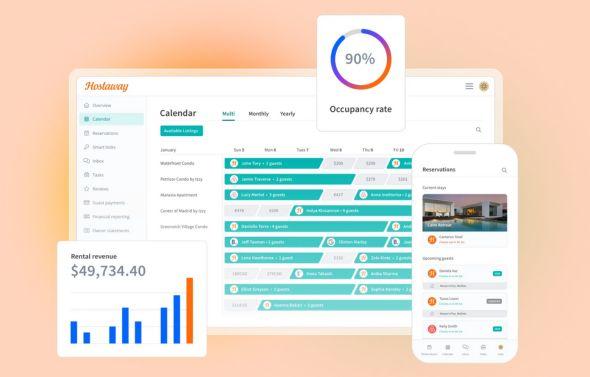
A channel manager is an external distribution tool, and in practice, something of a marketing tool too. It connects a property's booking calendar, rates and availability across multiple distribution channels like Airbnb, Vrbo, Booking.com and other online travel agencies (OTAs) so a property manager isn't updating each one manually.
The core job of channel management is multi channel distribution: get a listing in front of more potential guests through more booking channels, without multiplying the manual work.
It's tempting to treat a channel manager as a nice-to-have once a property manager has more than one or two listings. In practice, it becomes necessary the moment a property is live on more than one platform, because that's exactly when the risk of a booking conflict appears, even as those added channels bring in more bookings.
What does a channel manager do?
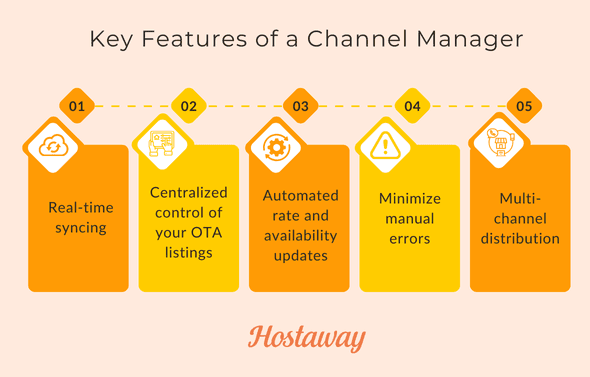
A channel manager connects to each OTA through an API and keeps room availability, pricing and reservation data synced in near real time. When a booking comes in on one connected channel, the channel manager pushes that update out to every one of the other channels automatically, which is what helps a property manager avoid double bookings, two guests booking the same unit on the same night.
This matters because reach and risk grow together. Listing on more OTAs helps a property manager find more guests, but every additional connected channel is another place a calendar can fall out of sync without automation.
A channel manager helps by removing the manual re-entry that introduces human error, someone forgetting to block a date on a second platform after a booking comes in on the first.
What is a property management system (PMS)?
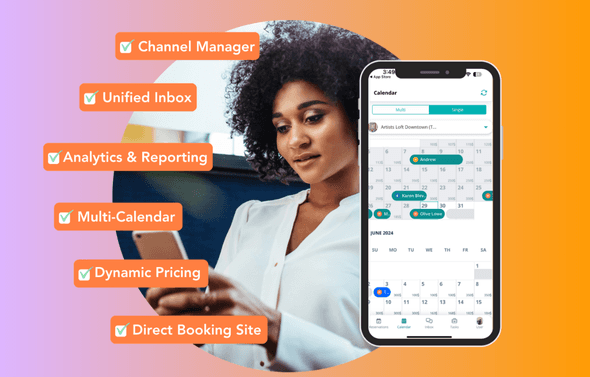
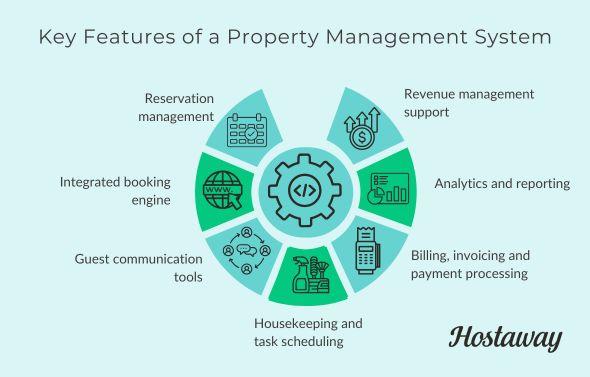
A property management system, also known as property management software, is the operational hub of a vacation rental business. Where a channel manager is external-facing (getting bookings in), a PMS is internal-facing, handling the internal tasks that shape the guest experience once a booking exists. It typically covers reservations, guest communication, guest check-ins, housekeeping and task scheduling, payment processing, and reporting.
Day to day operations in a growing vacation rental business generate a lot of small, repeatable tasks, and a PMS is built to absorb them whether you're a solo operator or managing on behalf of several property owners.
Breezeway's 2025 State of Work Report, which surveyed over 350 hospitality professionals, found that 45.5% of operators face last-minute guest issues daily, a volume of daily friction that's difficult to manage through spreadsheets and group texts alone.
What are the key differences between a channel manager and a PMS?
Whether you're comparing standalone tools or a combined pms channel manager platform, the clearest way to separate the two is by what each is actually optimizing for: a channel manager focuses on getting bookings in, while a PMS focuses on running the business once they arrive.
Feature / Function | Channel Manager | Property Management System (PMS) |
Primary purpose | Syncs listings, pricing and availability across OTAs | Manages daily operations like check-ins, payments, housekeeping |
Focus area | Distribution and multi channel visibility | Guest communication and internal workflows |
Automation type | External. Pushes updates to connected channels | Internal. Routes and tracks operational tasks |
Key users | Owners or managers overseeing multiple platforms | Property managers and on-site or remote teams |
Revenue support | Maximizes bookings and occupancy across channels | Tracks payments, expenses and business performance |
Distribution and operations are genuinely different disciplines. A channel manager is judged on listings performance across OTAs, while a PMS is judged on how smoothly daily operations run, which is why vacation rental software has historically kept them as separate categories even when, increasingly, they're sold together.
Do property managers need both a PMS and a channel manager?
For a single listing on a single platform, a channel manager adds little, there's nothing to sync. Past that point, the case for having both gets stronger with every additional listing and every additional OTA.
Running a channel manager without a PMS means bookings sync cleanly across platforms, but guest communication, housekeeping and payment processing still happen manually. Running a PMS without a channel manager means operations are organized, but each OTA calendar has to be updated separately, undoing the work a channel manager does to prevent double bookings in the first place.
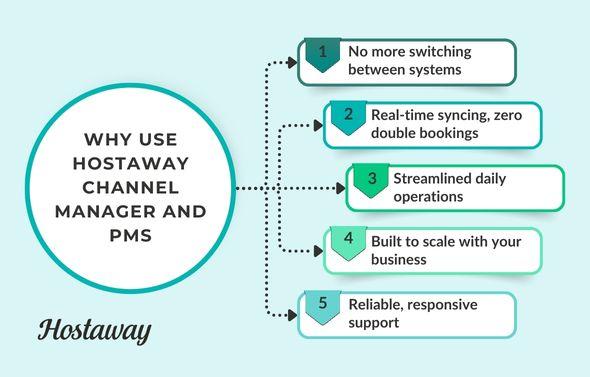
The businesses that feel this gap most are ones managing multiple listings across multiple online travel agencies, where a missed calendar update or a guest message that falls through the cracks isn't a minor inconvenience, it's a canceled stay or a bad review. That's the reasoning behind Hostaway's property management platform: rather than stitching a standalone channel manager to a separate PMS, both functions run on one central platform, so booking data and operational data are always the same data which is what actually helps streamline operations for property owners running multiple listings, rather than just connecting two separate tools.
How a PMS and Channel Manager Work Together
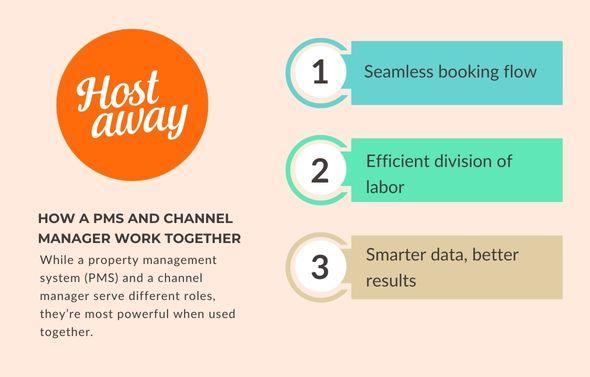
When the two are connected, whether as separate tools or as one platform, the data flow relies on two way communication between systems. A booking made on an OTA flows through the channel manager into the PMS, which immediately blocks that date everywhere else and creates the operational tasks around it: a cleaning assignment, a check-in message, an entry in the owner's revenue report.
Conversely, changes made inside the PMS, a new rate from a dynamic pricing tool, a blocked maintenance date, is push back out through the channel manager to every connected channel.
This is also the part that's easiest to get wrong when the two tools live in separate systems from separate vendors: every integration is another point where a sync can lag or fail silently. Hostaway runs the channel manager and PMS as one system with a single user interface, rather than two connected ones, so a rate change, a new reservation or a blocked date is the same update everywhere, not a message passed between two platforms that have to agree with each other.
Frequently Asked Questions
Can a channel manager replace a PMS?
No. A channel manager only handles distribution such as syncing listings, rates and availability across OTAs. It has no guest communication, housekeeping, or payment processing functionality, which is why property managers running only a channel manager still end up doing daily operations by hand.
What's the difference between a channel manager and a booking engine?
A channel manager connects a property to third-party OTAs. A booking engine powers bookings made directly on a property's own website, bypassing OTAs entirely. They serve opposite ends of the distribution strategy, one maximizes reach on other platforms, the other builds a direct channel.
Do I need a channel manager if I only list on one platform?
Not really, since there's no second calendar to keep in sync. The value of a channel manager appears specifically when a listing goes live on a second OTA, at which point manual updates become a double-booking risk rather than a minor inconvenience.
How does Hostaway combine a PMS and channel manager?
Hostaway runs both functions on one platform, so a booking from any connected OTA updates availability everywhere else automatically while also feeding the operational side, task scheduling, guest messaging, payment processing and reporting, without moving data between two separate systems.
What's the risk of using a PMS and channel manager that aren't integrated?
Manual work reappears in the gap between them. Without a live connection, a manager has to re-enter reservation data from the channel manager into the PMS by hand, which is where double bookings, missed guest messages and reporting errors tend to originate.
Is a PMS useful for hosts with just one or two properties?
Yes. Even at a small scale, a PMS automates guest messaging, check-in instructions and invoicing, and gives an operator a clear record of performance, useful groundwork well before a portfolio grows large enough to need a team.
Ready to find out how Hostaway can transform your business?